Jup ag creates different onchain commitments for spot swaps, perpetual trades, and lending.
Jup ag combines routed Solana token swaps, leveraged perpetual trading, and lending, but each function creates a different onchain commitment. A spot swap exchanges one asset for another and ends when the transaction settles. A perpetual trade remains open, with collateral, leveraged exposure, fees, profit or loss, and a liquidation boundary. Lend can create a redeemable vault share or an ongoing collateral-and-debt position. The common workflow is to inspect the proposed terms, sign only the intended transaction, check the submitted transaction using its Solana signature, and reconcile the resulting balances or position record. A quote shows an offer; confirmed state shows what actually happened.
Key takeaway: Each action leaves different evidence: swaps settle as balance changes, perpetuals remain open positions, and lending uses vault receipts or position records.
Three Functions and Three Commitments
Spot swaps convert one Solana asset into another through available decentralized exchange liquidity. Routing may use one market or split execution across several pools. The quoted output, price impact, slippage protection, route, and disclosed fees describe the proposed exchange, while the confirmed transaction records the amount that settled.
Perpetuals create continuing exposure rather than delivering the traded asset. Collateral supports a long or short position whose value changes with the market and accrued costs. Lending has another structure: Earn supplies assets to a vault, Borrow creates debt against collateral, and Multiply automates leveraged borrowing and reinvestment. Each path therefore needs its own completion check.
Terms That Separate Quotes, Positions, and Vaults
Jupiter’s products share a wallet connection and Solana settlement, yet their records answer different questions. The essential distinction is whether the transaction completes an exchange or creates a state that remains open.
Quote State
A quote is a time-sensitive proposal built from an input mint, output mint, amount, available liquidity, and execution settings. Token symbols aren’t sufficient identity checks because unrelated tokens can reuse them. The mint address identifies the asset that the transaction will actually move.
Confirmed State
Confirmed state is the onchain result after Solana processes the signed transaction. A swap changes token balances. A perpetual position records fields such as direction, size, collateral, entry price, and fees. A lending action produces a vault receipt or a collateral-and-debt record that persists until redemption or repayment.
How Does a Routed Swap Reach Final Settlement?
A routed swap reaches settlement when the signed transaction confirms and the destination token balance reflects the executed output. Before signing, the relevant facts are the exact input and output mints, amount spent, expected amount received, minimum protected output, price impact, and every displayed fee. A route is useful only while its underlying liquidity and prices remain available.
The wallet signature authorizes the transaction presented at that moment. After submission, the signature becomes the lookup key for its status. Success means the recorded instructions executed and the balance changes can be reconciled. A simulation, wallet approval, or submitted status alone doesn’t establish that the exchange settled.
Swap Terms That Can Change Before Execution
Swap terms move with pool liquidity, competing trades, network conditions, and the selected amount. Price impact describes how the order itself affects execution, while slippage protection limits deterioration between quoting and settlement. Those measures aren’t interchangeable.
- The input and output mint addresses establish token identity.
- The expected output describes the quote, not a guaranteed receipt.
- The minimum output defines the protected execution boundary.
- Price impact reflects available liquidity for that order size.
- Network, platform, or account costs should appear before approval.
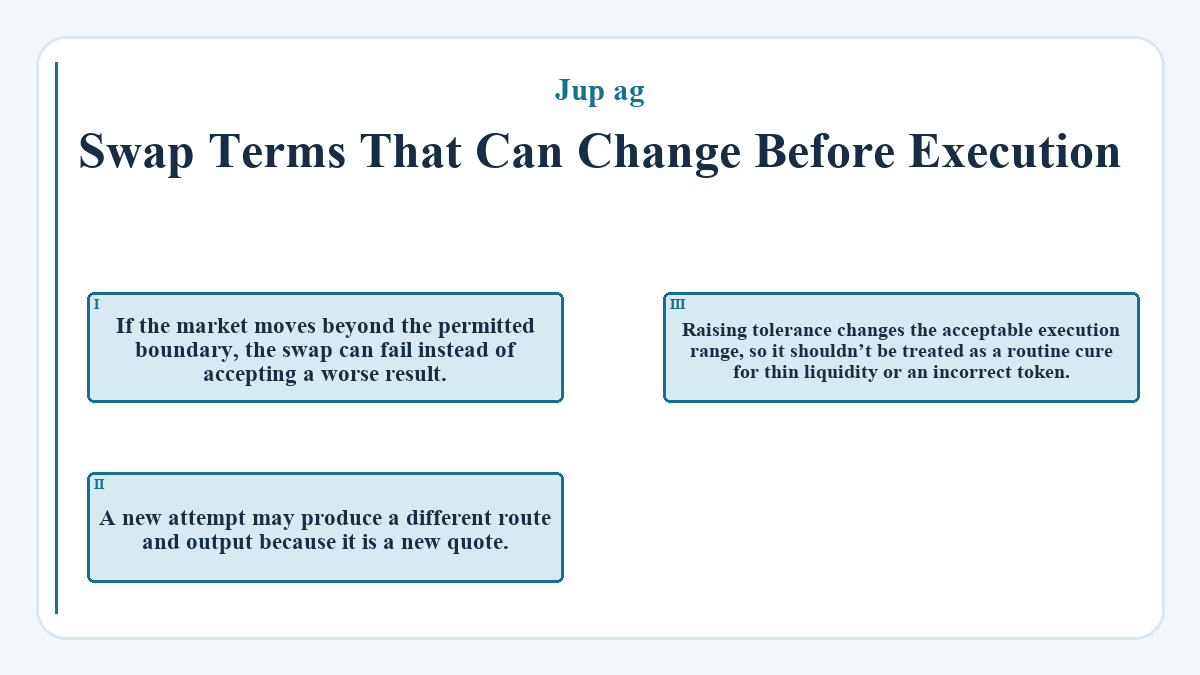
If the market moves beyond the permitted boundary, the swap can fail instead of accepting a worse result. A new attempt may produce a different route and output because it is a new quote. Raising tolerance changes the acceptable execution range, so it shouldn’t be treated as a routine cure for thin liquidity or an incorrect token.
Perpetual Positions Keep Risk Open
A perpetual position uses collateral to create leveraged directional exposure without a fixed expiry. The position remains sensitive to market price, borrowing costs, available pool liquidity, and its liquidation boundary until it is reduced or closed.
Collateral and Direction
Collateral is the capital supporting the position, while position size is the larger market exposure. Long positions benefit when the tracked market rises; short positions benefit when it falls. The interface may convert an input token into the collateral that the market requires, making the conversion cost part of the opening transaction rather than extra collateral.
Costs and Liquidation
Perpetual economics continue after entry, so the opening confirmation is only the starting record.
Costs That Accrue
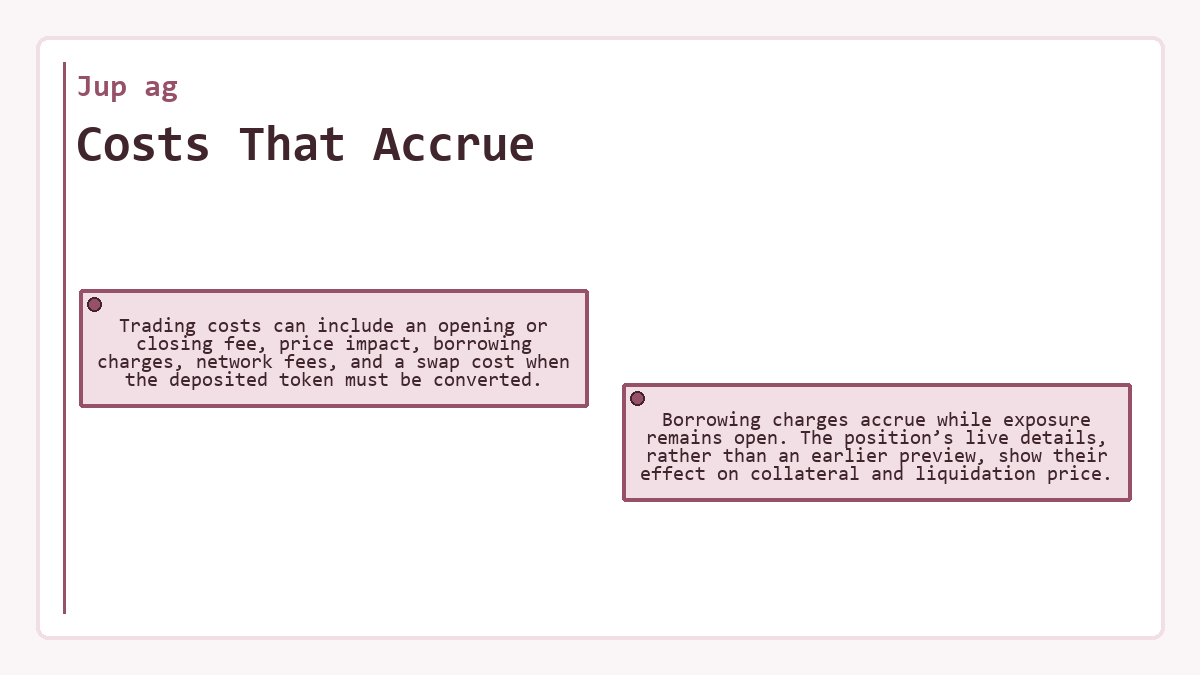
Trading costs can include an opening or closing fee, price impact, borrowing charges, network fees, and a swap cost when the deposited token must be converted. Borrowing charges accrue while exposure remains open. The position’s live details, rather than an earlier preview, show their effect on collateral and liquidation price.
Liquidation Boundary
A liquidation boundary marks the point where remaining collateral can no longer support the position under the protocol’s rules. Leverage narrows the distance between the market and that boundary. Adverse price movement and accumulating borrow fees can both move a position toward liquidation, even when the trader makes no further transaction.
When Is a Perpetual Position Actually Closed?
A perpetual position is closed when the decrease transaction has executed and the open position record shows no remaining size. Submitting a close request or approving a wallet prompt isn’t final proof. The transaction status and updated position state must agree.
A partial decrease realizes the corresponding portion of profit or loss while leaving the rest exposed. Full closure returns the remaining collateral after realized results and applicable costs. Liquidation is a different exit: the protocol closes an undercollateralized position under its liquidation rules rather than following a voluntary target.
JLP and the Trader-Pool Relationship
JLP represents a share of the asset pool that backs Jupiter Perpetuals and pays profitable traders. The same pool receives trading fees and bears the other side of trader performance. Its value therefore reflects the pool’s assets, collected fees, trader profit and loss, and the composition of liquidity rather than a fixed interest payment.
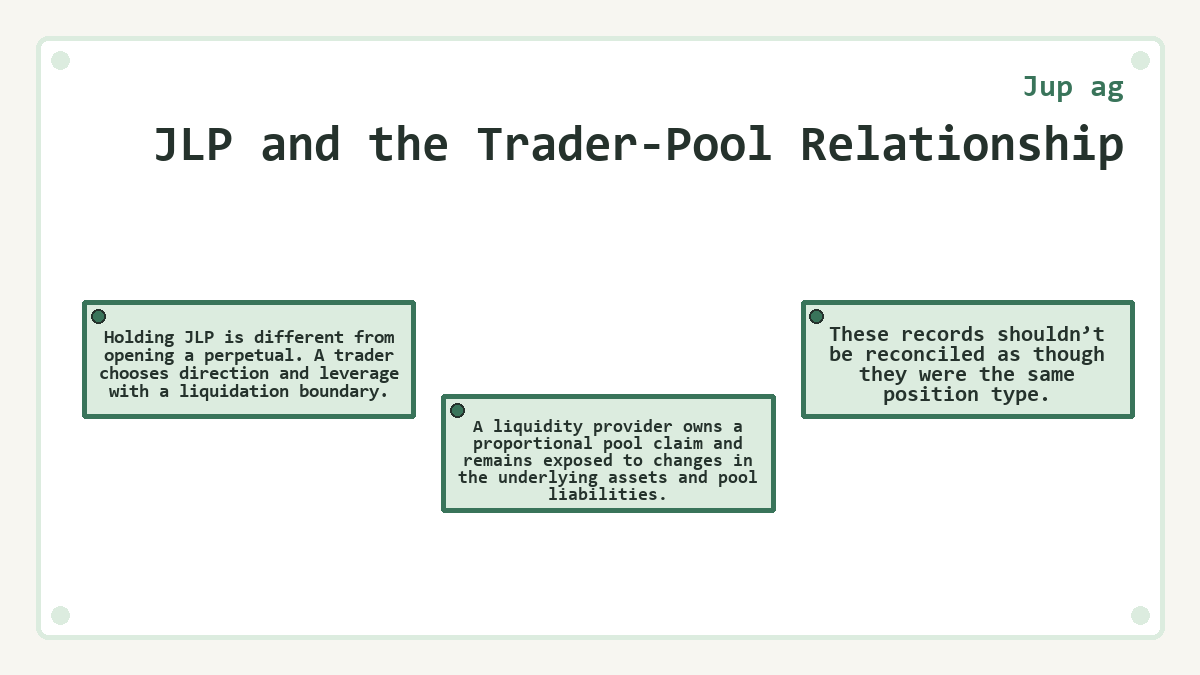
Holding JLP is different from opening a perpetual. A trader chooses direction and leverage with a liquidation boundary. A liquidity provider owns a proportional pool claim and remains exposed to changes in the underlying assets and pool liabilities. These records shouldn’t be reconciled as though they were the same position type.
Lend Splits Into Earn, Borrow, Multiply, and Strategies
Jupiter Lend groups several actions around shared liquidity, but each action creates a distinct claim or obligation.
- Earn supplies an asset to a vault and returns a JL Token representing the depositor’s share.
- Borrow locks supported collateral and creates debt under the selected vault’s parameters.
- Multiply borrows against collateral, swaps the borrowed asset, and redeposits it to create leveraged exposure.
- Strategies use preset vault and leverage choices built on the same Multiply mechanics.
Earn rates vary with borrowing demand, and withdrawals depend on available vault liquidity and dynamic limits. Borrow and Multiply positions depend on live loan-to-value limits, liquidation thresholds, interest rates, and debt ceilings. Those parameters belong to the selected vault; a rate or threshold seen on one pair doesn’t describe every lending position.
What Confirms a Lending Position Exists?
An Earn position is confirmed by a successful deposit transaction and the corresponding JL Token in the wallet. The receipt token represents a share of the vault, so its quantity needn’t match the underlying deposit one for one. Yield accrues through the changing redemption value rather than repeated token distributions.
Borrow, Multiply, and Strategies use a Position NFT to represent ownership of the continuing collateral-and-debt record. Transferring that NFT transfers control of the position, including its obligations. A dashboard is useful for reading the state, but the transaction, receipt token, and position account are the durable evidence.
One Wallet, Different Onchain Records
Each product has a separate record of completion and a separate condition for leaving it.
| Action | Record That Confirms It and Ends It |
|---|---|
| Routed swap | A confirmed transaction records input and output balance changes; settlement leaves no continuing swap position. |
| Perpetual trade | An open position records size, collateral, direction, and costs; it ends after a confirmed full close or liquidation. |
| Lending | A JL Token records an Earn claim, while a Position NFT represents ownership of a Borrow, Multiply, or Strategy position; exit requires redemption, repayment, or unwind. |
The connected address ties these records together without making them interchangeable. A wallet balance can prove receipt after a swap, but it can’t show whether a perpetual still has exposure or whether a lending vault has enough available liquidity for a full withdrawal.
Reconciliation, Exit, and Failed Transactions
Reconciliation starts with the transaction signature and ends with the product-specific state. For a swap, compare the confirmed input spent and output received. For perpetuals, compare position size, collateral, entry data, fees, and open status. For Earn, match the deposited asset to the JL Token claim. Borrow and Multiply also require checking collateral, outstanding debt, and position health.
A failed atomic transaction applies none of its intended program state changes, although Solana may still charge a processing fee. A pending or failed action should therefore be checked before it is repeated. If the original record remains open, a new transaction changes that existing exposure; if it closed successfully, repeating the action could create an unintended second commitment.
Jup ag questions worth asking
Why Can a Token Balance Have No Available Swap Route?
A wallet balance doesn’t guarantee that a tradable market exists. Jupiter may return no route when liquidity is missing, the amount is outside executable bounds, or the token has transfer restrictions. Confirm the mint address first, then adjust the amount and check for available liquidity without assuming that every Solana token can be sold.
Can the Same Solana Account Appear in Different Wallet Apps?
Yes, two compatible wallet apps can display the same Solana account when they import the same recovery material and derive the same address. Creating a new account with the same email doesn’t establish that connection. Recovery phrases and private keys should be entered only into a trusted wallet import flow, never into a website or support message.
Is SOL Required Before Every Jup Ag Action?
Most signed Solana transactions require SOL for network fees and sometimes account creation costs. Certain swap flows may offer gasless execution and deduct a disclosed cost from the traded assets instead. Availability varies by transaction, so the approval screen must explicitly show gasless handling before a zero-SOL balance can be treated as sufficient.
Can a JL Token Be Transferred to Another Address?
Yes, a JL Token is a transferable Solana token representing a claim on an Earn vault. Sending it transfers that claim to the recipient, who can redeem the underlying value under the vault’s withdrawal conditions. The original depositor no longer controls the transferred share, so it shouldn’t be handled like an unrelated reward token.
Why Might an Earn Withdrawal Be Temporarily Limited?
An Earn withdrawal may be limited when part of the supplied liquidity is being used by borrowers or a dynamic withdrawal limit restricts the available amount. The displayed vault balance isn’t the same as immediately withdrawable liquidity. A smaller withdrawal or a later attempt may become possible when liquidity returns or the limit expands.
Does Closing a Perpetual Position Erase Its Onchain History?
No, closing a perpetual ends the remaining market exposure but doesn’t remove prior transactions from Solana. The opening, adjustments, fees, and closing action remain associated with their transaction signatures and accounts. The useful closure check is that the close transaction succeeded and the position shows no open size, not that its history disappeared.
Will a Failed Solana Transaction Change a Position or Balance?
A failed atomic transaction doesn’t apply its intended program state changes, so it shouldn’t partly open, close, swap, or unwind a position. A network processing fee may still be charged. Check the signature status and current balances or position data before retrying, because a delayed successful transaction can look like a failure in an interface.
Is Transferring a Position NFT Equivalent to Transferring Its Debt?
Yes, a Jupiter Lend Position NFT represents ownership and control of the associated Borrow, Multiply, or Strategy position. Moving the NFT transfers control of the complete position, including its collateral and outstanding debt. Burning it or sending it unintentionally can prevent the original wallet from managing or withdrawing the position.