Jup ag Results Can Be Confirmed With Transaction Records and Account State
A Jup ag action is complete only when the confirmed record matches the intended balance or position state. Signing a wallet prompt authorizes a Solana transaction; it doesn’t prove settlement by itself. The signature identifies the signed transaction, while its status, balance changes, and any resulting position account show what actually happened. A swap should end with the destination asset credited. An Earn deposit should leave a vault receipt, while Borrow, Multiply, Strategies, and perpetual positions remain open until their obligations are resolved. A clean exit therefore requires a successful transaction plus the expected terminal state, with no unintended debt or exposure left behind.
In this guide
A clean exit is confirmed by settled balances and closed obligations, not by a wallet signature alone.
Match the Record to the Commitment
Two broad paths determine what completion means: a terminal exchange and an ongoing position. A routed swap seeks one settled balance change and doesn’t create a continuing Jupiter position. Earn produces a redeemable vault claim. Borrow, Multiply, Strategies, and perpetual trading create state that must be managed after the opening transaction. Treating every successful signature as the same kind of result hides those differences.
Before signing, every selected amount, route, and position setting remains a proposal that can be changed or abandoned.
Swap review centers on the input asset, destination asset, quoted output, minimum accepted output, price impact, disclosed fees, and wallet address. A position requires different checks: collateral, debt or exposure, direction where applicable, and the condition that can force liquidation. Where the transaction requires the wallet to pay network fees, the fee-paying account also needs enough SOL. The wallet request should reflect the action that was prepared.
The intended completion record should be clear before authorization. For a swap, that record is the successful transaction plus the resulting token balances. An Earn deposit should produce the corresponding JL Token balance. Debt-based products need a position record showing the expected collateral and debt. If the wallet request describes a different asset, amount, or action, rejecting it preserves the starting state while the inputs are corrected.
What Turns a Wallet Signature Into Settled State?
A successful status at the required confirmation level, paired with the intended account change, turns authorization into settlement evidence. A signature can exist before a transaction has landed, and a submitted transaction can still fail. Its status must show no execution error. The relevant balances or position accounts must then show the result that the action was meant to create.
A confirmed Solana transaction record can expose execution status, fees, and pre- and post-token balances through its metadata. Those fields let a reader distinguish the network fee from token movement and compare the starting record with the settled record. Parsed instructions can add context, but the observed account state remains the practical test of completion.
Position state adds a second check. A successful transaction status proves execution, while the account or token receipt proves that the intended commitment now exists.
Position Receipts and Open Obligations
Persistent positions leave different records because ownership, value, and continuing obligations aren’t represented in one universal balance. The receipt must be interpreted according to the product that created it. A tokenized vault share, a Position NFT, and a perpetual position entry answer different questions even when the same wallet controls them.
Vault Receipts
In Jupiter Lend Earn, the JL Token in a wallet represents its holder’s claim on the corresponding vault assets. Its token quantity isn’t expected to mirror the amount of underlying assets deposited. The share’s redemption value accounts for accrued yield, so an unchanged JL Token balance can represent a changing amount of underlying assets.
Transferring a JL Token transfers the claim rather than moving a separate deposit record back to the original wallet. Burning it, sending it to an unintended address, or losing control of the holding account can remove the ability to redeem the underlying assets. A full withdrawal also depends on available vault liquidity because some supplied assets may be in active loans.
Debt Positions
Borrow and Multiply positions use a Position NFT to identify ownership of the associated collateral, debt, and risk settings. Moving that NFT transfers control of the whole position. The NFT isn’t merely a collectible receipt, so it shouldn’t be burned or transferred casually while collateral or debt remains attached.
Borrow and Multiply
Borrow reaches a clean exit when the debt is repaid and the remaining collateral is returned to the wallet. Multiply adds automated leveraged exposure by borrowing, swapping, and redepositing within the position. Its Unwind action can reduce or close the exposure, using collateral to repay debt before returning what remains. A partial unwind lowers exposure but doesn’t establish a full exit while debt or collateral remains in the position.
Strategies
Strategies package a leveraged position behind a defined entry and withdrawal flow. Their withdrawal is a full unwind rather than a partial redemption: the position’s debt is repaid, and the remaining assets return to the wallet after applicable swap and interest costs. The Position NFT can remain after closure because it may be reused for a later position. Its continued presence alone doesn’t prove that exposure is still open.
Seven Actions and Their Exit Evidence
Each action has its own completion record and recovery boundary. Reading the wrong record can produce a false positive, such as treating a Position NFT as proof that debt is still outstanding or treating a signature as proof that a swap succeeded.
| Action | State Record | Clean Exit or Recovery Condition |
|---|---|---|
| Routed swap | Successful transaction and changed token balances | Destination balance is credited; no continuing Jupiter position remains |
| Earn deposit | JL Token balance representing the vault claim | JL Tokens remain controlled until they are redeemed or intentionally transferred |
| Earn withdrawal | Redeem or withdrawal transaction with updated balances | Shares are redeemed and the corresponding underlying assets reach the wallet |
| Borrow position | Position NFT plus recorded collateral and debt | Debt reaches zero and remaining collateral is withdrawn |
| Multiply position | Position NFT plus leveraged collateral and debt state | Full Unwind repays debt and removes the remaining leveraged exposure |
| Strategy position | Position account and reusable Position NFT | Full withdrawal returns net assets; the NFT may remain by design |
| Perpetual position | Open position state with collateral and exposure | Open exposure is removed, and the closing transaction remains traceable |
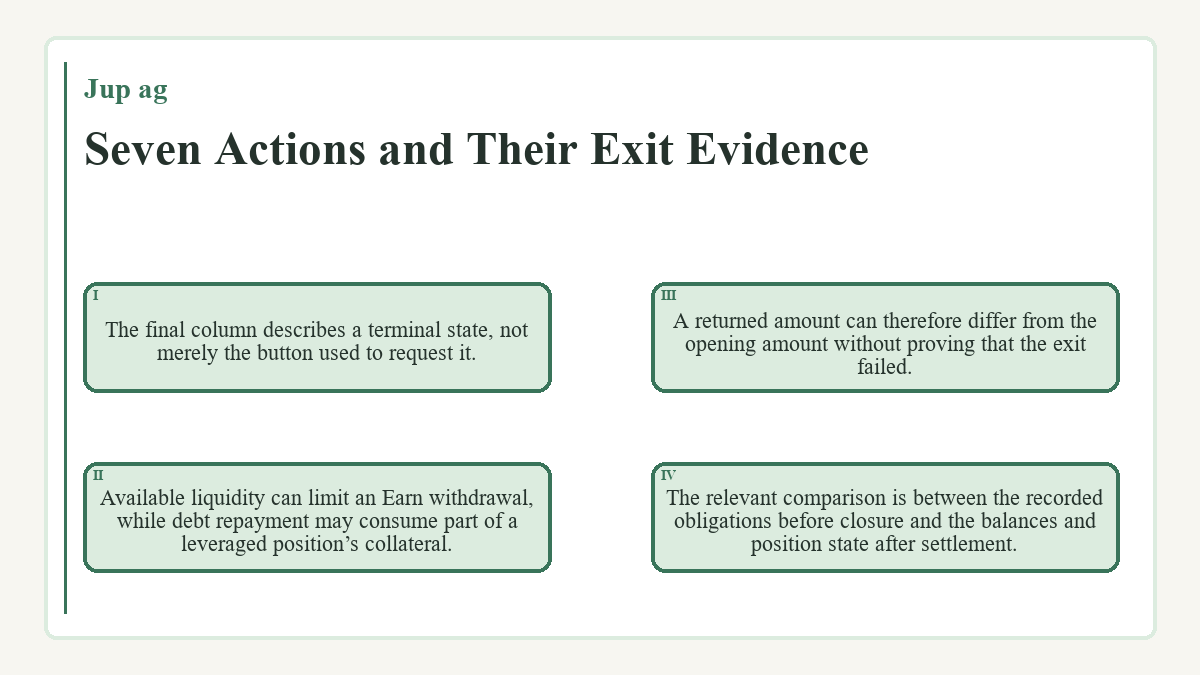
The final column describes a terminal state, not merely the button used to request it. Available liquidity can limit an Earn withdrawal, while debt repayment may consume part of a leveraged position’s collateral. A returned amount can therefore differ from the opening amount without proving that the exit failed. The relevant comparison is between the recorded obligations before closure and the balances and position state after settlement.
When Is an Exit Actually Complete?
An exit is complete when the observed onchain state matches the terminal condition for that product. A settled swap needs the destination balance. Earn needs the vault shares redeemed and underlying assets credited. Borrow and Multiply need debt resolved, with any intended collateral returned. A perpetual trade needs its open exposure removed. A success notification without those state changes is incomplete evidence.
The starting record makes that comparison possible. Before an exit, note the controlling public key, relevant token balances, receipt ownership, collateral, debt, and open exposure. After confirmation, compare the same fields. This expected-state versus observed-state check separates a clean closure from a transaction that settled correctly but performed only part of a multi-transaction workflow.
A Solana transaction commits its instructions atomically, so a failed instruction prevents that transaction from applying a partial state change. That property covers instructions bundled inside one transaction. It doesn’t combine several separately signed transactions into one all-or-nothing operation.
Separate signatures create separate settlement boundaries. If an earlier transaction succeeds and a later one fails, the first state change can remain. Repeating the entire workflow without reading the updated accounts may request an action that no longer matches the current position. The next request should be built from the state that actually settled.
Residual State and Wallet Recovery
A missing interface row isn’t proof that a position vanished. Reconnect the controlling public key, inspect the transaction status, and read the associated balances or position record. Another wallet application can display the public account, but it can manage the position only when it can sign for the controlling address. Seed phrases and private keys shouldn’t be entered into a webpage or shared with support contacts. For JL Tokens and Position NFTs, retaining control of the receipt is part of retaining control of the position.
Helpful answers about Jup ag
Can a Quote Be Used as Proof of the Settled Swap Amount?
No. A quote describes proposed terms before execution and doesn’t change an onchain balance. The settled amount must be read from a successful transaction and the resulting token accounts. If the quote expires or routing conditions change before signing, a new quote may produce different terms without altering the wallet’s starting state.
Why Can the Interface Lag Behind a Confirmed Transaction?
The interface may rely on cached or indexed data that updates after the underlying Solana account. Check that the same public key is connected, then compare the transaction status and current token or position accounts. A delayed interface refresh doesn’t reverse a confirmed state change, though a failed transaction will leave the intended change absent.
Is the Network Fee Included in the Destination Token Amount?
No. Solana records the network fee separately and charges it to the transaction’s fee payer, normally from a SOL balance. The destination token amount reflects the executed exchange or withdrawal. Other disclosed costs and price movement can affect that received amount, while slippage protection determines whether changed terms remain acceptable. Compare the transaction metadata with the prepared terms.
Can an Earn Position Survive a Transfer of Its JL Token?
Yes, but control of the claim moves with the JL Token. The receiving address can redeem the corresponding vault assets, while the original wallet no longer holds that claim. A transfer should therefore be treated as a transfer of the Earn position, not as an ordinary copy or backup of its receipt.
Why Can a Full Earn Redemption Be Temporarily Unavailable?
A vault may lack enough immediately available liquidity because some supplied assets are being used in active loans. The position still exists through its JL Token, but a full withdrawal may require a smaller redemption or a later attempt after liquidity returns. The displayed yield or share balance doesn’t remove that liquidity constraint.
Is Zero Debt Enough to Confirm That Collateral Was Returned?
No. Zero debt confirms only one part of a Borrow or Multiply exit. The wallet balance must also show the intended collateral return, and the position record should show no residual exposure that the user meant to close. Fees, swaps, and debt repayment can make the returned quantity differ from the original collateral amount.
Does Rejecting a Wallet Request Create a Jup Ag Position?
No, provided the request was rejected before signing and submission. An unsigned prompt doesn’t submit a Solana transaction or change an account. If a request was signed before the interface reported an error, check for a transaction signature and settled state before preparing a replacement, because the original submission may still have landed.