Jup ag Fits When the Onchain Outcome Matches the Job
Jup ag is a strong fit when a Solana task ends in a record you can recognize and manage: a settled token swap, an open perpetual position, or a lending claim or debt position. It is a conditional fit when success depends on live liquidity, variable rates, collateral health, or continued monitoring. A selected path is a poor fit when it cannot provide a required fixed price or return, when leverage would go unmonitored, or when it settles only on Solana but the job requires another chain. Judge each path by the state it creates, the cost inputs shown before approval, and the obligation that remains afterward. A wallet approval authorizes an attempt; the confirmed balance or position is the usable outcome.
Choose the path whose confirmed record matches the job: a settled swap, a redeemable vault claim, or a managed open position.
A Strong Fit Starts With the Required End State
The required end state separates a suitable path from one that merely looks convenient. Swaps, perpetuals, and lending positions can share a wallet interface while creating different records, risks, and exit requirements.
Settled Exchange
A settled exchange is the right target when one Solana asset should become another without leaving an open Jupiter position. The destination balance and confirmed transaction should agree with the accepted terms.
Redeemable Claim
A redeemable claim fits a holder who accepts variable yield and vault liquidity conditions. The relevant record is the vault-share token, not the unchanged quantity of the asset originally supplied.
Open Exposure or Debt
An open position fits only when continued management is part of the job. Perpetuals, Borrow, and Multiply retain exposure after entry, so their current health and eventual exit matter as much as the opening transaction.
Spot Swaps Fit Immediate Solana Conversions
Spot swaps are a strong fit for converting an available Solana token into another supported token through accessible liquidity. Jupiter Spot can split a swap across multiple liquidity sources when that route offers better overall execution. The quote should identify the input, expected output, price impact, disclosed costs, and protective output condition before approval.
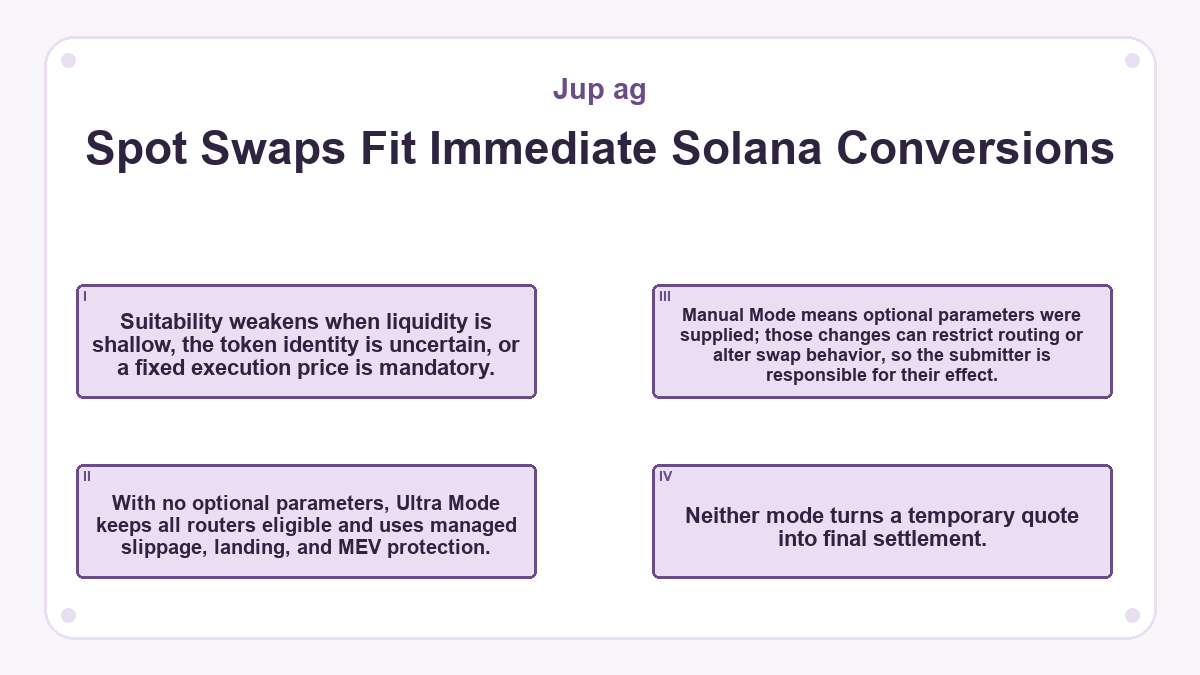
Suitability weakens when liquidity is shallow, the token identity is uncertain, or a fixed execution price is mandatory. With no optional parameters, Ultra Mode keeps all routers eligible and uses managed slippage, landing, and MEV protection. Manual Mode means optional parameters were supplied; those changes can restrict routing or alter swap behavior, so the submitter is responsible for their effect. Neither mode turns a temporary quote into final settlement.
Quotes and Confirmed Balances Must Agree
A quote describes an available route under live market and network conditions. The expected state is the stated conversion within its protective terms. The observed state is the confirmed transaction plus the resulting wallet balance. If the transaction fails, remains unresolved, or credits an unexpected asset, the intended conversion is not complete.
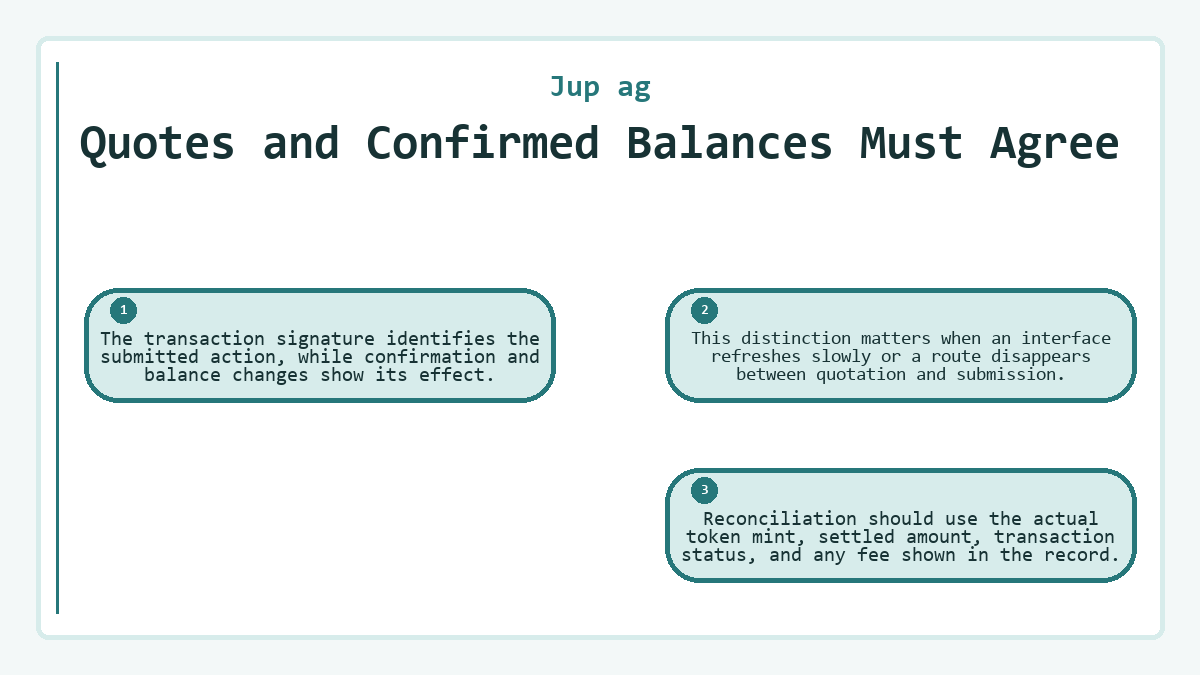
The transaction signature identifies the submitted action, while confirmation and balance changes show its effect. This distinction matters when an interface refreshes slowly or a route disappears between quotation and submission. Reconciliation should use the actual token mint, settled amount, transaction status, and any fee shown in the record.
Perpetuals Fit Managed Directional Exposure
Perpetuals are a conditional fit for leveraged long or short exposure that can be monitored until closure. Entry creates a continuing position with collateral, profit or loss, fees, and a liquidation boundary.
Direction and Collateral
Direction determines how price movement affects the position, while leverage determines how strongly that movement affects the supplied collateral. The order summary should match the intended market, side, size, entry terms, collateral, and estimated liquidation price. For long-only exposure without debt or liquidation risk, a spot purchase is a closer alternative.
Position Economics and Exit
Borrow fees accrue while a leveraged position remains open and reduce the collateral that supports it. Adverse price movement or accumulated costs can move the position toward liquidation. A suitable user therefore needs an exit plan, enough collateral headroom, and a way to inspect the open record rather than relying on the original confirmation.
Earn Fits Variable Yield With a Redeemable Claim
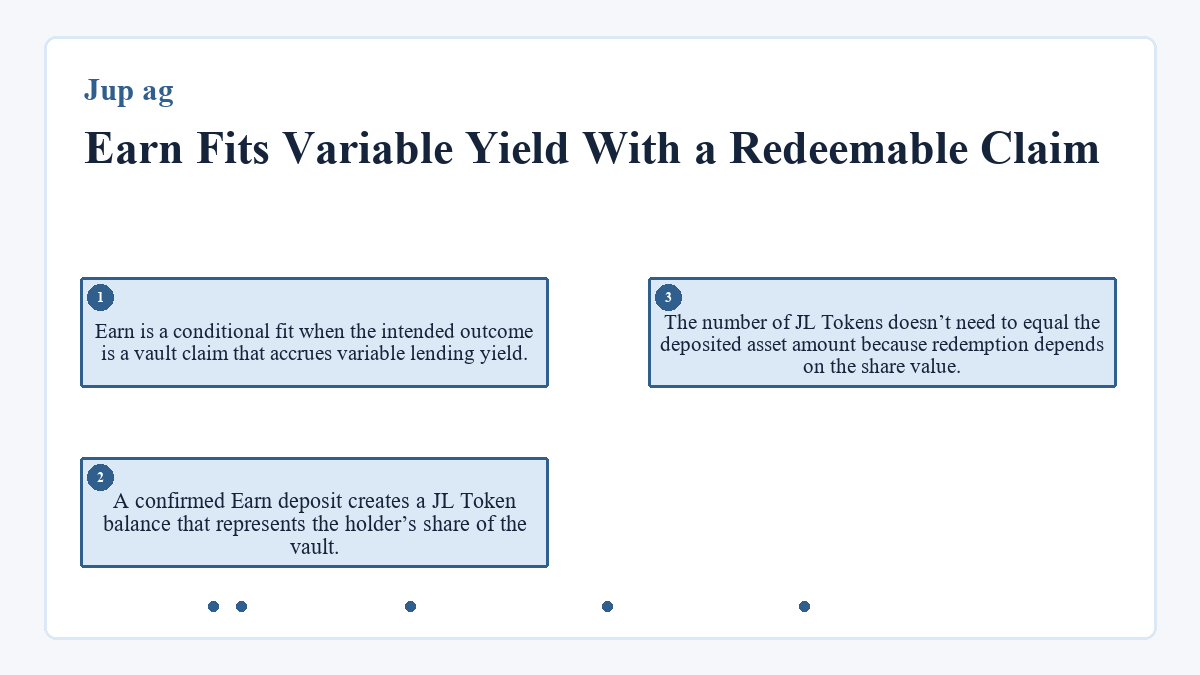
Earn is a conditional fit when the intended outcome is a vault claim that accrues variable lending yield. A confirmed Earn deposit creates a JL Token balance that represents the holder’s share of the vault. The number of JL Tokens doesn’t need to equal the deposited asset amount because redemption depends on the share value.
Rates respond to borrowing demand, so a displayed APY is a snapshot rather than a fixed return. Jupiter’s automated debt ceiling can limit how much is withdrawable at once, with capacity increasing each block. A requirement for a known rate and maturity points toward an arrangement with explicit fixed terms instead. Earn fits when variable yield, transferable claim ownership, and liquidity-dependent withdrawals are acceptable.
Borrow and Multiply Require an Ongoing Risk Budget
Borrow fits when collateral should remain deposited while another supported asset is borrowed against it. The live LTV, debt amount, liquidation threshold, interest rate, and position health determine whether that structure remains workable. A Position NFT represents ownership of the collateral-and-debt position, so moving the NFT moves the entire obligation rather than one isolated component.
Multiply automates borrowing, swapping, and redepositing to create leveraged exposure in an atomic operation. That convenience doesn’t remove debt, rate changes, or liquidation risk. It is suitable when the chosen exposure justifies active monitoring and the position has room for adverse movement. Ordinary Earn or an unleveraged spot holding is a closer match when the job excludes debt and forced collateral sales.
Live Inputs Define Cost, Capacity, and Failure
Live inputs determine whether an otherwise supported action is available and acceptable. The table separates the value that needs inspection from the failure that can prevent the intended outcome.
| Product Path | Value to Inspect | Main Failure Mode |
|---|---|---|
| Spot swap | Quoted output, route, price impact, and disclosed costs | The quote expires, liquidity changes, or settlement fails |
| Ultra Mode | All routers eligible, with managed slippage, priority fees, and transaction landing | Market or network conditions change before execution |
| Manual Mode | Custom slippage, priority fee, and route settings | Settings can restrict routing; low slippage can block execution, while high slippage permits a worse price |
| Perpetual position | Collateral, leverage, liquidation price, and continuing fees | Price movement or costs consume the available margin |
| Earn vault | Variable APY, available liquidity, JL Token claim, and withdrawal limit | The rate falls or full redemption is temporarily constrained |
| Borrow or Multiply | LTV, debt, liquidation threshold, health, and Position NFT | LTV crosses the liquidation threshold, or transferring the Position NFT moves the whole position |
These values don’t support a promised fixed outcome. Swap cost changes with the execution mode, route, network demand, and trade conditions. Perpetual and lending costs also depend on position size, utilization, time, and live protocol parameters. Compare the displayed inputs before approval with the record observed after execution.
Alternative Order Types Solve Different Timing Problems
Limit and DCA orders fit timing requirements that an immediate swap doesn’t address. A limit order waits for its trigger condition, yet triggering doesn’t guarantee a complete fill. Available liquidity and the accepted slippage still govern execution, and a remainder can stay active after a partial fill.
DCA spreads an intended conversion across scheduled suborders. It is useful when timing distribution matters more than immediate completion, but each suborder remains exposed to liquidity, slippage, and network conditions. A failed suborder can retry at its next scheduled interval. Neither order type suits a deadline that requires guaranteed execution at one exact price.
Poor Fits Share Missing Conditions
Poor fits appear when the required outcome conflicts with how the selected product settles, changes over time, or stays open. The alternative should remove that conflict instead of hiding it behind a simpler interface.
Fixed Price or Return Requirements
A fixed outcome requirement doesn’t match a live swap quote, variable lending APY, or utilization-based borrowing cost. Use a structure with explicit fixed terms when the price, rate, and maturity must be known in advance. A limit order supplies a trigger, not a guaranteed fill.
Unmonitored Obligations
An unattended position is a poor match for perpetuals, Borrow, Multiply, or maximum-leverage Strategies. Their health can change after entry because prices, rates, debt, and available collateral change. A settled spot conversion or unleveraged holding removes the continuing debt-management requirement, although asset price risk remains.
Different Settlement Targets
A Solana spot conversion doesn’t place funds on another blockchain. When the required destination is a different network, use an explicitly cross-chain deposit or bridge flow and confirm the destination-chain receipt. Treating a local token swap as a cross-chain transfer leaves the required settlement unfinished.
A suitable Jup ag path therefore has a compatible starting asset, an acceptable live quote or position setup, and a recognizable completion record.
Questions and answers about Jup ag
Can Jup Ag Fit a Wallet That Has No SOL for Network Fees?
Sometimes. A quoted swap can be gasless through automatic sponsorship or a market maker that pays network and priority fees. Automatic sponsorship recovers its cost through the swap fee, reducing the output amount. Availability depends on the wallet’s SOL balance, trade size, route, and any custom payer or referral settings. If the quote isn’t gasless, the wallet needs enough SOL for network fees and any required token-account rent.
Is a Zero price-impact Estimate Evidence That a Token Is Safe?
No. Price impact describes how the proposed trade interacts with available liquidity; it doesn’t prove the token is legitimate or safe. Mint authority, freeze authority, liquidity concentration, token identity, and transfer restrictions are separate concerns. A favorable execution estimate can coexist with serious token-level risks.
Why Might an Earn Withdrawal Redeem Only Part of a Position Immediately?
Jupiter Lend smooths Earn withdrawals with an automated debt ceiling, so a large position may not be redeemable all at once. Withdrawal capacity increases each block. A smaller redemption may therefore succeed sooner, while the remaining JL Tokens continue to represent the unredeemed share.
When Can a Triggered Limit Order Remain Unfilled?
A triggered order can remain wholly or partly unfilled when available liquidity cannot satisfy it within the permitted slippage. The trigger starts an execution attempt; it doesn’t reserve liquidity or guarantee the estimated output. Any unfilled remainder can stay active until it fills, expires, or is cancelled.
Does Adding Collateral Make a Perpetual Position Suitable for Unattended Use?
No. Extra collateral can lower leverage and move the liquidation boundary farther from the current price, but the position remains open. Price movement and continuing borrow fees can reduce its margin later. Adding collateral changes the buffer; it doesn’t remove the need to monitor and eventually close the position.